Engineering polymeric membranes from first principles to the production line.
Prakash Membrane Consulting bridges continuum theory, COMSOL multiphysics modeling, structured experimentation (design, data analysis), and roll-to-roll manufacturing — delivering finer control of microstructure during scale-up of ultrafiltration (UF), microfiltration (MF), and thin film composite (TFC) membranes among others.
- 01Membrane formation science, R2R manufacturing
- 02NIPS/TIPS phase inversion technique
- 03COMSOL Multiphysics modeling
- 04Filtration/separation science, particle trajectory analysis
To provide membrane technology organizations with high-level scientific and engineering guidance in membrane formation, transport phenomena, and manufacturing — combining mechanistic modeling with experimentally actionable process insight.
To help shape the next generation of membrane technologies by uniting theory, experimentation, and industrial scale-up into a single engineering framework.
A rare intersection of theory, experiment, and manufacturing.
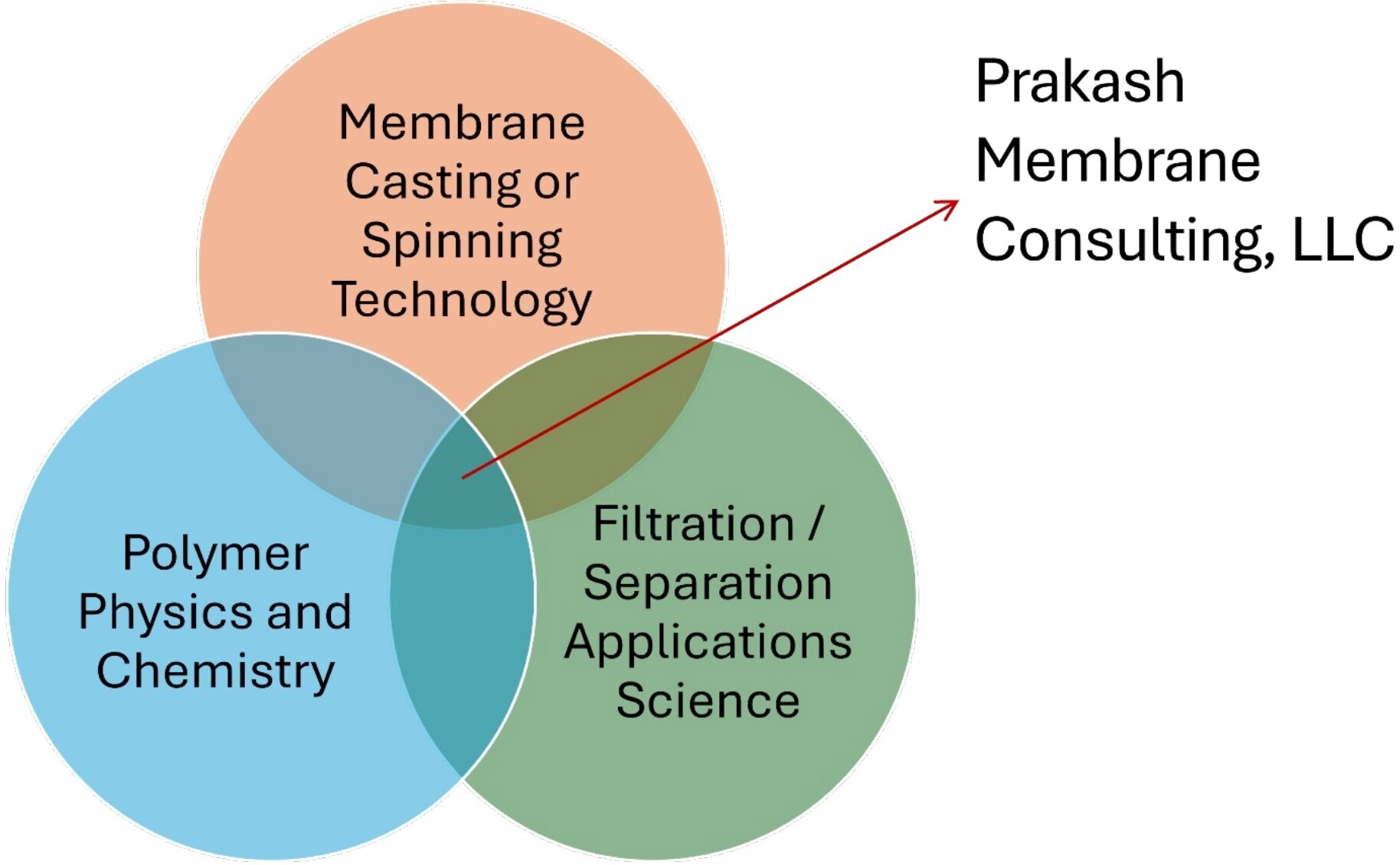
Most membrane problems live at the seam between disciplines. We work where polymer physics, transport phenomena, and roll-to-roll process engineering converge.
Where membrane casting, polymer science, and separation applications meet.
Our unique value proposition is finer control of membrane microstructure during manufacturing scale-up — interpreting SEM, AFM, porometry and porosimetry data through state-of-the-art theoretical paradigms such as process path analysis.
See how we work