Technical
Process path analysis — from ternary diagram to membrane microstructure.
Mapping the composition trajectories of a casting film during nonsolvent-induced phase separation (NIPS) onto the resulting polysulfone membrane cross-section.
Fig. 01
Process path analysis (sketch) mapped onto SEM cross-section

ζ = z / L(t) ∈ [0, 1] · dimensionless depth across the casting film during nonsolvent-induced phase separation. Local composition at each depth traces a path through the polymer / solvent / nonsolvent ternary diagram, crossing the binodal and spinodal envelopes at different times — producing the dense skin, fine-pored intermediate zone, and open-celled porous substructure observed in the SEM.
Fig. 02
Process path analysis (computational results)
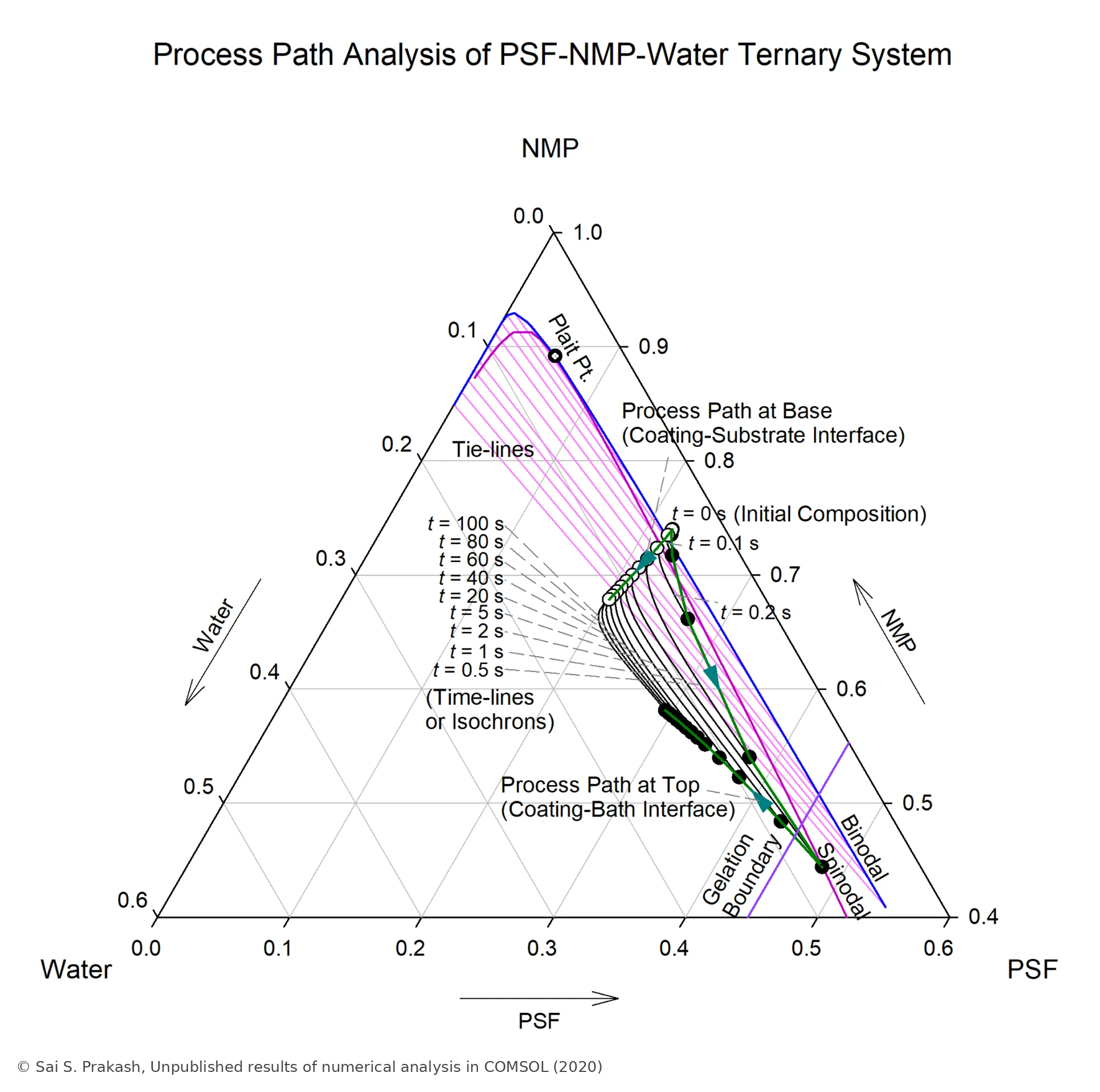
Process path analysis of a Polysulfone-NMP-Water ternary polymer solution coating undergoing NIPS (nonsolvent-induced phase separation) to form an asymmetric membrane suitable for separation applications. The 1D model incorporates a multicomponent Fickian diffusion formalism with concentration-dependent diffusivities of Vrentas-Duda (highly nonlinear, coupled). The model is solved using COMSOL (equation-based). The effects of cross-term diffusivities appear pronounced.
Fig. 03
Spatio-temporal compositional evolution
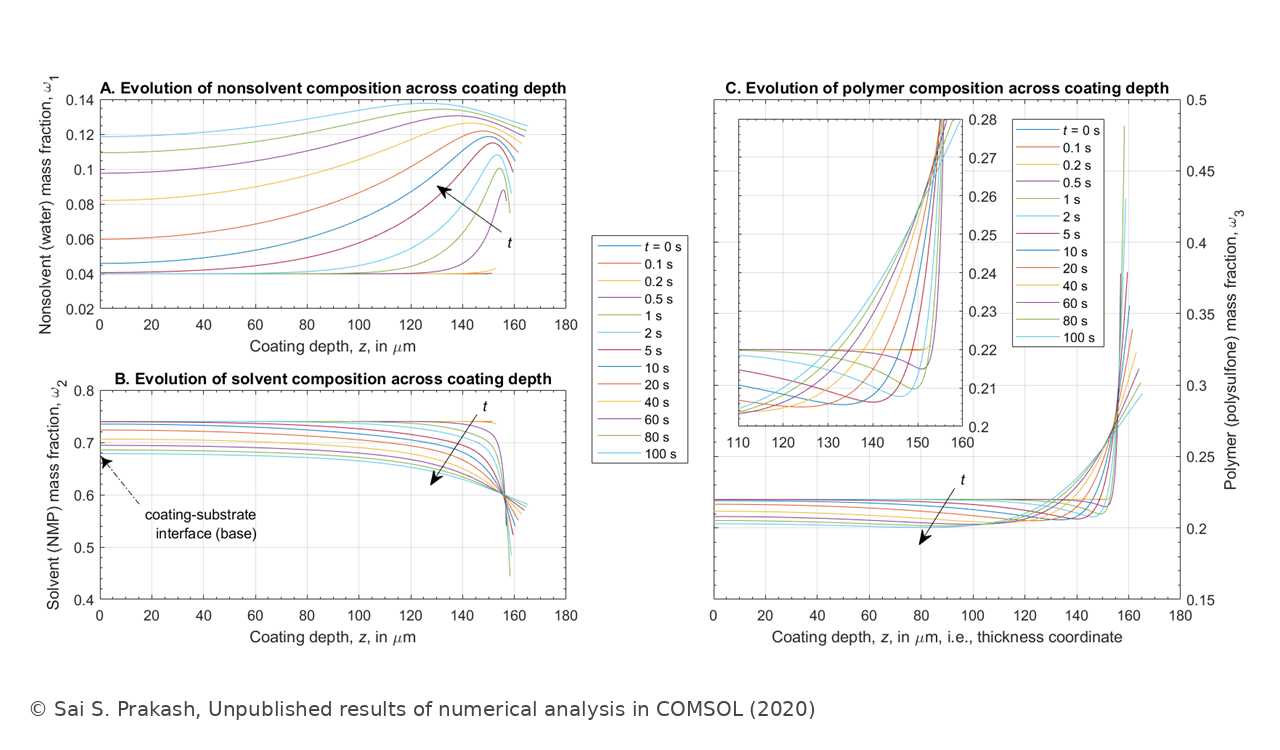
Spatio-temporal compositional evolution of individual components of the above ternary system (coarse-grained). Note the moving coating-bath interface (coating swells).